
A Self-Improving Analytics Stack That Does Not Grade Itself
An AI analyst gets worse as the data under it changes. This is a design for a loop that turns failed questions into reviewed changes to the data stack, where no part of the system writes the test it is judged by.
An AI analyst that is right on launch day does not stay right. I have seen it happen in a deployment I worked on. The agent passed its evals (test questions with known correct answers), and people started to use it. Over the following weeks the answers got worse. The agent had not changed. The tables and metric definitions under it had, and nobody updated the notes it reads about them.
Anthropic reported the same pattern in its analytics agent: accuracy fell from about 95% at launch to about 65% within a month. It is back at about 95% now that the team treats keeping those notes current as engineering work.
The Thoughtworks article Making Your Data Ready for Agentic AI states the rule for the repair: "Fix the definition, not the prompt." Ian Macomber's The Shape and Feel of the Post-AI Data Stack, written from his work on Ramp's internal research agent, puts a feedback loop at the centre of the stack. Every correction a data scientist makes, he writes, "only compounds if you build the infrastructure to catch the error, trace the process, and distribute the fix to your entire company". Neither article describes that infrastructure in detail, and this article is my design for it.
In the obvious version, one system finds the problem, changes the code and tests the change. In this design, the component that makes a change never writes or sees the test for it.
The design in one picture#
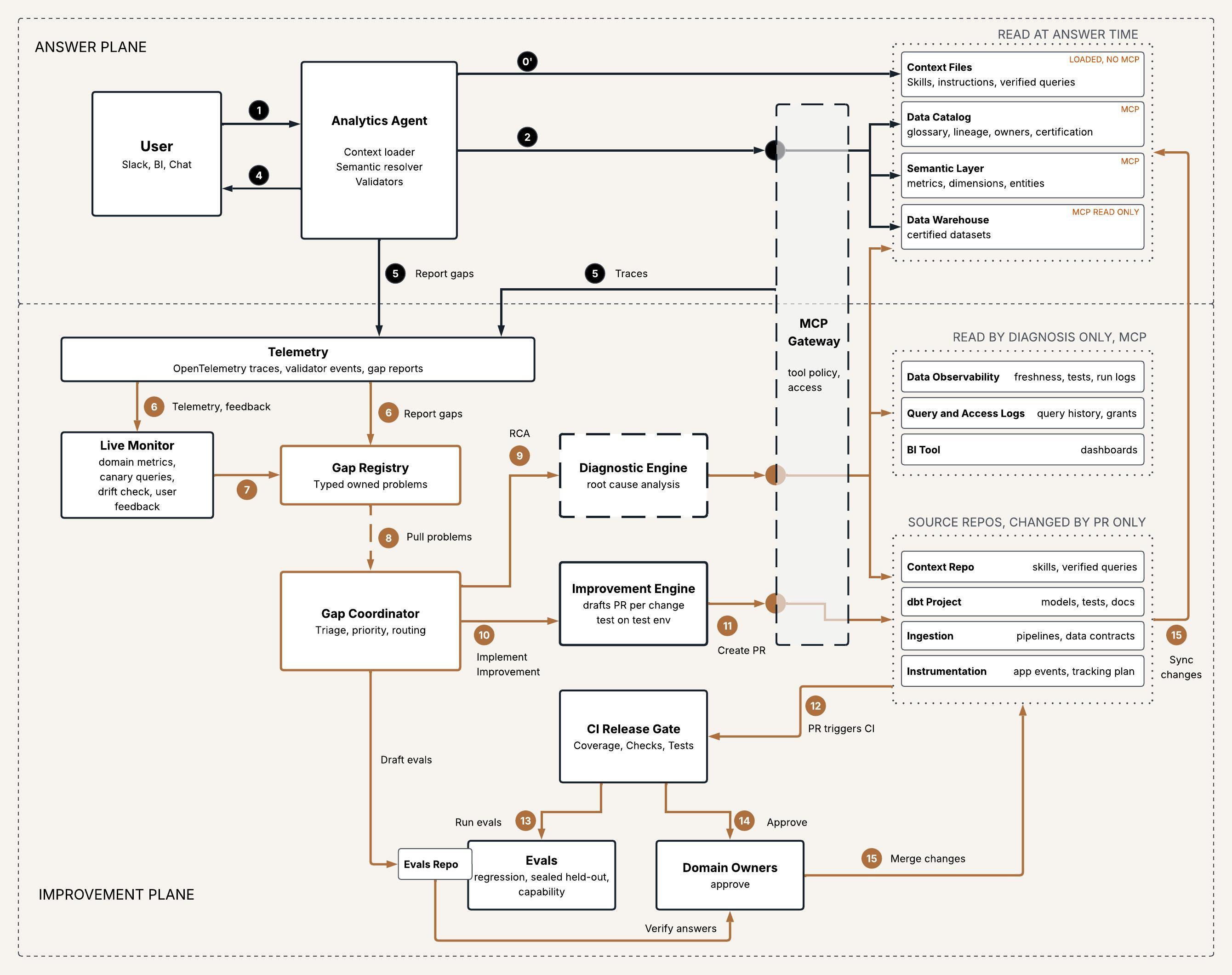
The design has two parts, which the diagram calls planes. The answer plane handles one question in seconds. The improvement plane works over days. Black numbers mark the answer plane, copper numbers the improvement plane. When a number appears twice, both arrows belong to the same step. Step 0' happens once per session, before any question is asked.
Answer plane · one question, in seconds
- 0'
Analytics agent → Context files
The agent loads its context files: written notes about tables and metrics, plus example queries known to be correct. This is a file load. It does not go through the gateway. - 1
User → Analytics agent
A user asks a question in Slack, a BI tool or a chat window. - 2
Analytics agent → MCP gateway → Catalog, semantic layer, warehouse
The agent looks up definitions and runs queries. Every call goes through the MCP gateway. MCP is the standard protocol that connects an agent to its tools, and the gateway decides what each caller may do. - 4
Analytics agent → User
The agent answers, or refuses and gives a reason from a fixed list. - 5
Analytics agent, MCP gateway → Telemetry
The agent reports each gap, meaning the information it was missing. The gateway sends a trace of every tool call.
Improvement plane · one gap, over days
- 6
Telemetry → Live monitor, Gap Registry
Traces and user feedback go to the live monitor. Gap reports go straight to the registry. - 7
Live monitor → Gap Registry
The monitor adds what it finds. It runs fixed test queries with known answers every day, flags data model changes made without a matching context file change, collects user corrections, and reports domain metrics after a fix ships. - 8
Gap Registry → Gap Coordinator
The coordinator pulls the next problem, in priority order. - 9
Gap Coordinator → Diagnostic engine
Root cause analysis. The diagnostic engine reads through the gateway with read-only access: everything the agent reads, plus data observability, query and access logs, BI dashboards and the source repositories. - 10
Gap Coordinator → Improvement engine
The coordinator passes on the root cause and the layer to change. - 11
Improvement engine → MCP gateway → Source repos
The engine opens a pull request in the repository that owns the layer: the context repo, the dbt project, ingestion or instrumentation. Before that, it can replay the failing question in a test environment. It cannot see the eval cases. - 12
Source repos → CI release gate
The pull request triggers the release gate. - 13
CI release gate → Evals
CI runs the regression cases, the capability cases for this gap, and the held-out questions. - 14
CI release gate → Domain owners
If the gate passes, CI asks the owners for approval. - 15
Domain owners → Source repos → Read at answer time
The owners merge, and the change syncs into what the agent reads.
Two arrows have no number because they happen at the same time as diagnosis (step 9). The Gap Coordinator drafts eval cases into the evals repo, and domain owners verify the expected answers.
Why the system must not grade itself#
A system that is optimised against a score can raise the score without fixing the problem. In the Darwin Gödel Machine experiments, an agent that could rewrite its own code got a perfect score on a hallucination check. It did not fix the hallucination. It changed what the check could detect. The authors call this objective hacking.
In analytics, an eval case is a question with a verified number. If one engine writes the fix, the question and the number, a passing test only shows that the engine agrees with itself.
Databricks keeps these roles apart in Genie, its AI analyst: benchmark questions are separate from the context the agent learns from. This design applies the same separation to every part of the loop.
Each component gets only the access it needs#
The MCP gateway gives each component only the access in this table.
| Component | Reads | Writes |
|---|---|---|
| Analytics agent | Context files, catalog, semantic layer, certified warehouse tables | Nothing |
| Diagnostic engine | All of the above, plus data quality and pipeline monitoring, query and access logs, BI dashboards, every source repository | Nothing |
| Improvement engine | Source repositories | Branches and pull requests only |
| Gap Coordinator | Gap Registry | Draft eval cases |
| Domain owners | Everything they own | Verified answers, approvals, merges |
The diagnostic engine reads widely because a wrong answer can start in any layer. A wrong revenue number can come from an outdated context file. It can also come from a metric that does not state its grain (what one row represents), a pipeline that failed last night, or an event the app never sends. The diagnostic engine looks at all of them and can replay the failing question in a test environment.
Macomber lists the questions his team asks when an eval fails: "Was the domain context ambiguous? Was the data model incomplete, or defined in code outside of the agent's purview? Did the user have the access they needed?" Each question points to a different layer. The fix for the last one is a permission, and for this reason the diagnostic engine also reads access logs.
The improvement engine cannot push to the main branch or approve its own pull request. Its code does not run in CI until a person approves the run. GitHub documents similar controls for its Copilot cloud agent. In the incidents I have read about where an AI agent damaged data, the agent had direct write access to production. One example is the Replit coding agent in July 2025.
Who writes the test cases#
There are three sets of test cases. All of them live in the evals repo, which neither engine can read. Take one gap as the example: the agent refused "What was net revenue in Germany last quarter?" because no metric excluded refunds.
| Set | What it checks | Who writes it | Example |
|---|---|---|---|
| Capability | The fix works | The Gap Coordinator drafts it, a domain owner checks the answer | The failing question and two rephrasings, each with the net revenue figure finance signed off |
| Regression | Nothing that worked before broke | Capability cases, moved here once a fix ships | A case from an earlier fix: "Weekly active users in September" |
| Held-out | The agent got better on real questions | People label real questions asked after a cutoff date | "How many new merchants activated in the UK last week?", picked at random from last month's questions |
The held-out set never includes a question used to build a fix, and the Gap Coordinator does not see it. Its score is the only one I would show leadership.
The registry starts with a few gap types: a missing or unclear definition, an outdated context file, missing data or a missing event, and a missing permission. Hamel Husain and Shreya Shankar recommend building failure categories from real traces, so I would revise these after reading the first hundred reports.
What counts as better#
Coverage is the share of answerable questions the agent attempts instead of refusing. A silent error is a confident number that is false: a wrong answer, or an answer to a question that has none.
Coverage alone is easy to raise: the agent just refuses less. So a change passes the release gate only if:
- coverage goes up,
- silent errors do not go up,
- no regression case fails.
After the change ships, three signals tell the registry whether the gap is closed:
- Semantic-layer share: the share of answers that went through the semantic layer instead of hand-written SQL. Anthropic calls it "the single most actionable number we tracked". A drop usually means a context file has drifted, or a new kind of question has appeared.
- Correction rate: how often people dispute an answer.
- Consensus divergence rate: Macomber's check at Ramp. Ask for each board-deck metric through every interface and model, and count the different answers. For board metrics it should be zero.
What I could not find, and what is unproven#
Several vendors now suggest fixes automatically. Snowflake, Databricks, and the BI tools Omni and Hex each change the semantic-layer definitions inside their own product. Anthropic and Grab go further: an agent drafts a pull request and a domain owner reviews it. Most of those pull requests change context files. I found no published system that traces a failed question back to a missing tracking event or a missing pipeline and fixes it there.
That part is also the least proven. Nobody has published how an analytics agent's failures split between missing or outdated context and data that was never collected. Anthropic's results point to context. If that holds, the registry and the release gate deliver most of the value, and the part that changes pipelines and tracking events can wait. I would measure the split before building it.
So the first parts I would build are the Gap Registry and the release gate. Neither of them needs write access to anything.
Sources & further reading
- Agentic Analytics: Teaching an AI Analyst to Say I Don't Know — Dmitry Ustimov, Decision Spine
- Making Your Data Ready for Agentic AI — Pramod Sadalage and Prem Chandrasekaran
- How Anthropic enables self-service data analytics with Claude — Anthropic
- Self-service data analytics in Slack: how Anthropic deploys Claude Tag for ad-hoc questions — Anthropic
- How AI is transforming analytics at Grab — Grab Engineering
- Test and monitor a Genie Agent — Databricks
- Suggestions for semantic models and views — Snowflake
- Suggestions — Omni
- Introducing Context Studio — Hex
- Darwin Godel Machine: Open-Ended Evolution of Self-Improving Agents — Zhang, Hu, Lu, Lange and Clune, 2025
- Risks and mitigations for GitHub Copilot cloud agent — GitHub
- AI-powered coding tool wiped out a software company’s database in ‘catastrophic failure’ — Fortune, July 2025
- The Shape and Feel of the Post-AI Data Stack — Ian Macomber
- AI Evals: Everything You Need to Know — Hamel Husain and Shreya Shankar
Read next
- Agentic Analytics13 min
What an AI Analyst Needs From Your Semantic Layer
A governed metric is not a governed answer. Every parameter of the query must be grounded in a source the analyst can point to. Here is what to put in your semantic layer, and how to measure whether it is ready.
Read - Agentic Analytics20 min
What It Takes to Trust an AI Analyst
Lessons from six experiments on building reliable AI analytics: trusted data, governed definitions, a bounded verification harness, and evaluation that can see silent failure.
Read - Agentic Analytics10 min
How an AI Analyst Knows What It Can Answer
A closed-world ontology turns answerability from a model judgement into a system check: governed, computable but undefined, or unsupported by the warehouse.
Read
Want to see where your AI analytics can silently fail?
The AI Analytics Reliability Audit benchmarks your AI analyst against real business questions and leaves you with a prioritized repair plan.